
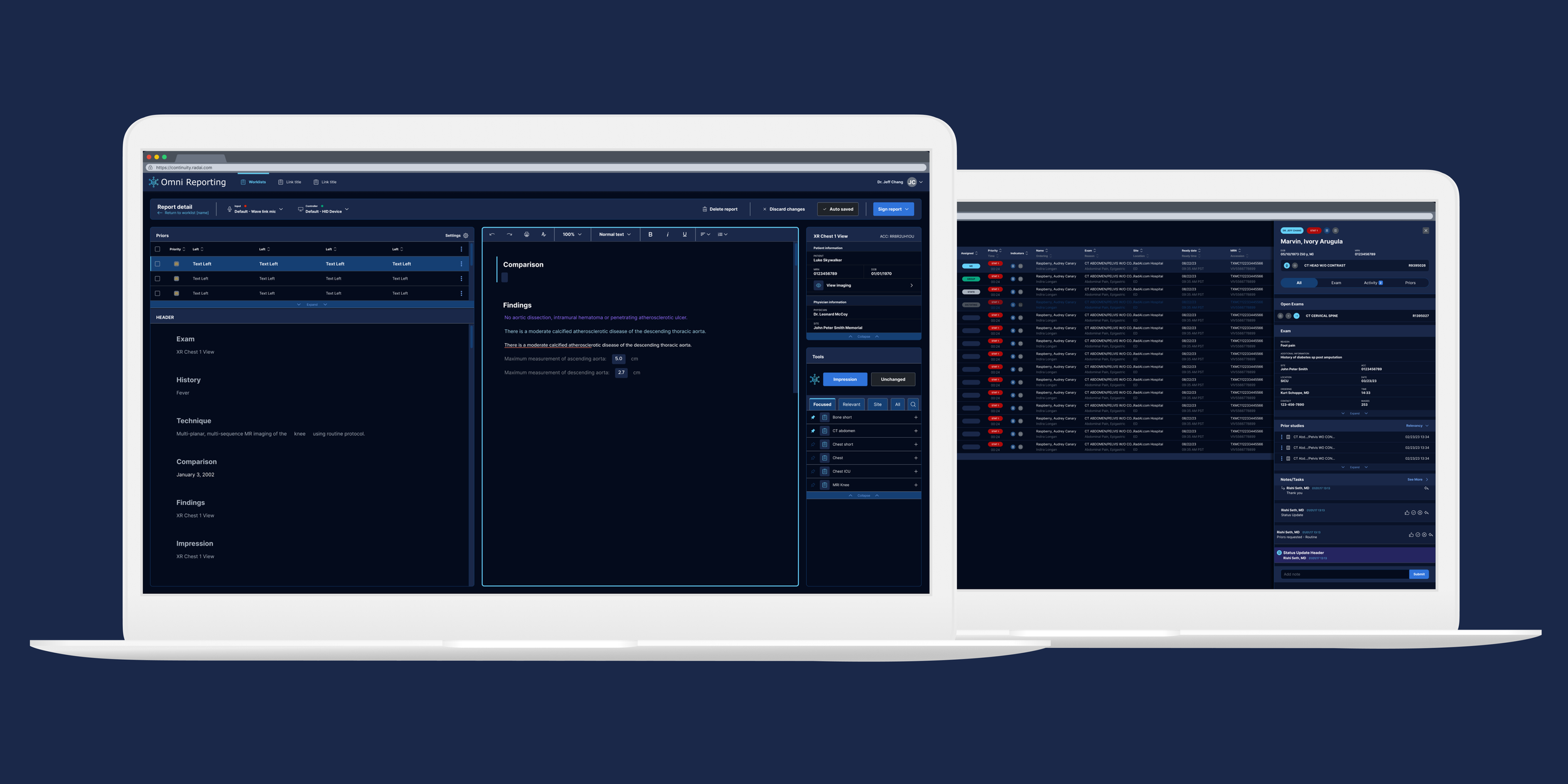
AI Radiology App
Led design early stages of a generative AI solution for radiology, designed by and for radiologists to address challenges like rising patient volumes, a shrinking workforce, and provider burnout.
2025 / Product Design Lead
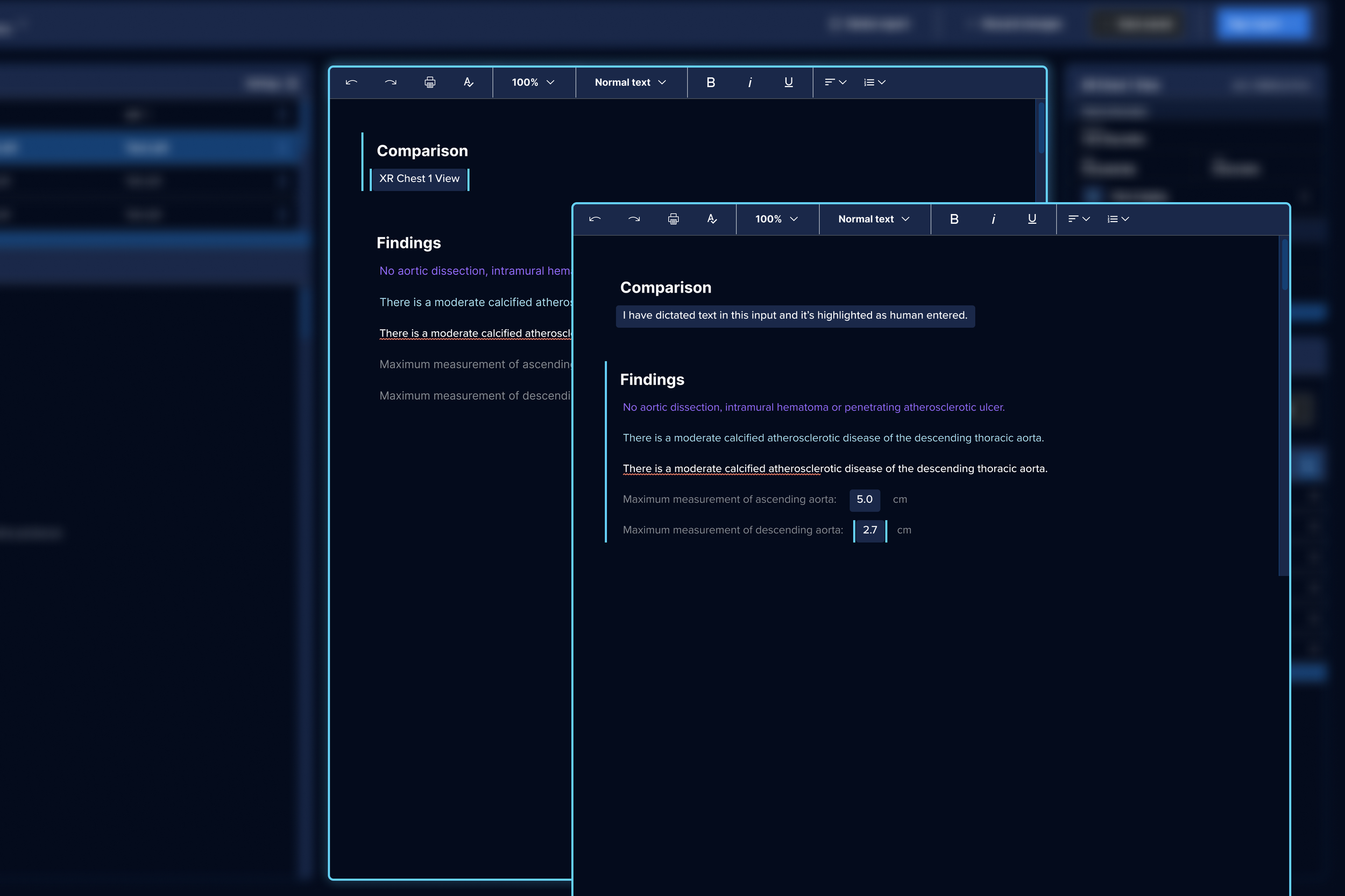
The First On-Canvas Generative AI Reporting Tool
RadAI was one of the first platforms to bring generative AI directly onto the reporting canvas for radiologists. By the time the work shipped, the tool improved report quality by 60% and earned strong praise from the Director of the Duke University LCS program for how it handled complex clinical workflows. The same work ultimately supported better care decisions for thousands of patients.
Unified
Design System
½
Time to Report
60%+
Report Quality
Automated
Treatment Plans
-
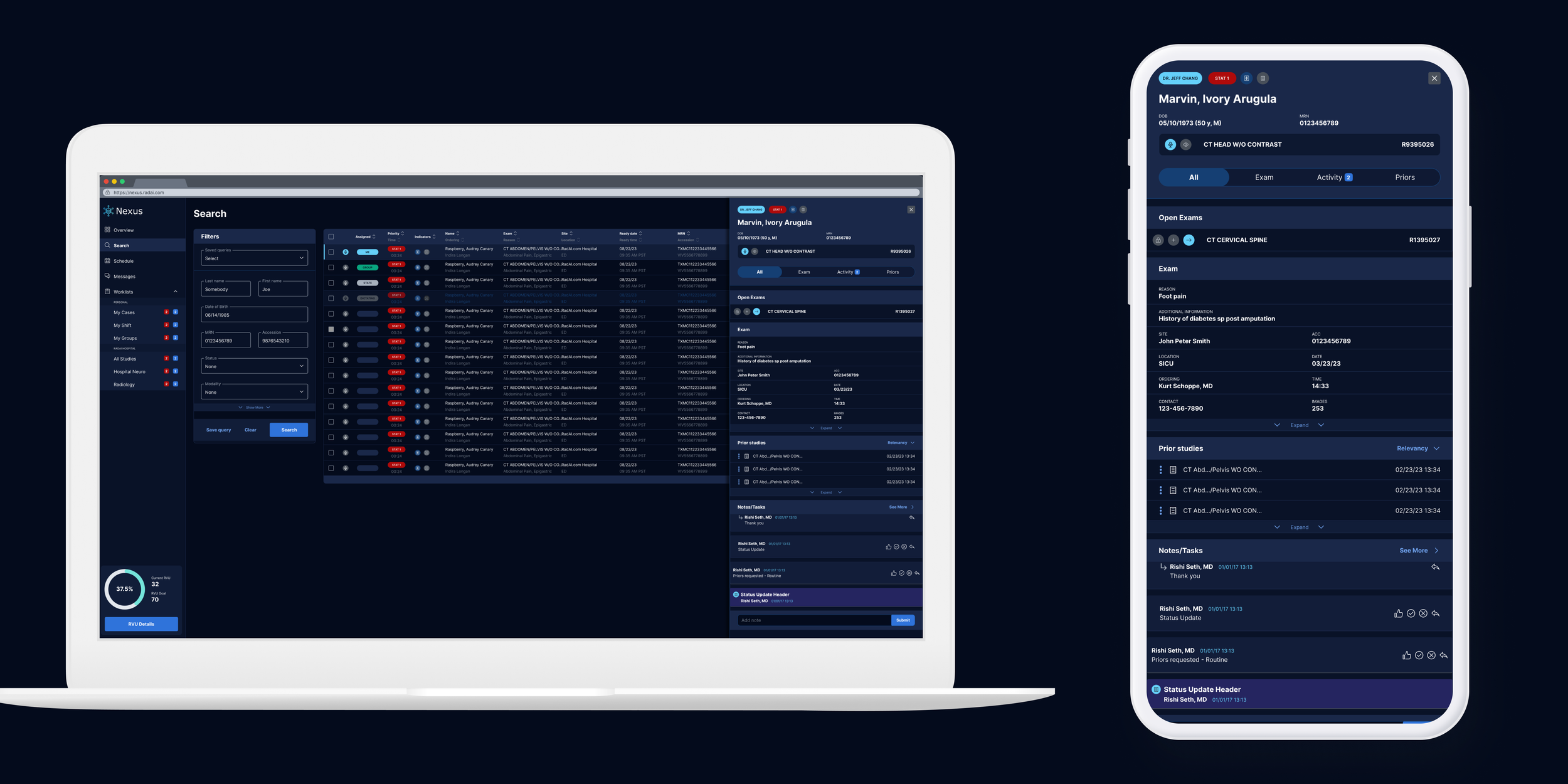
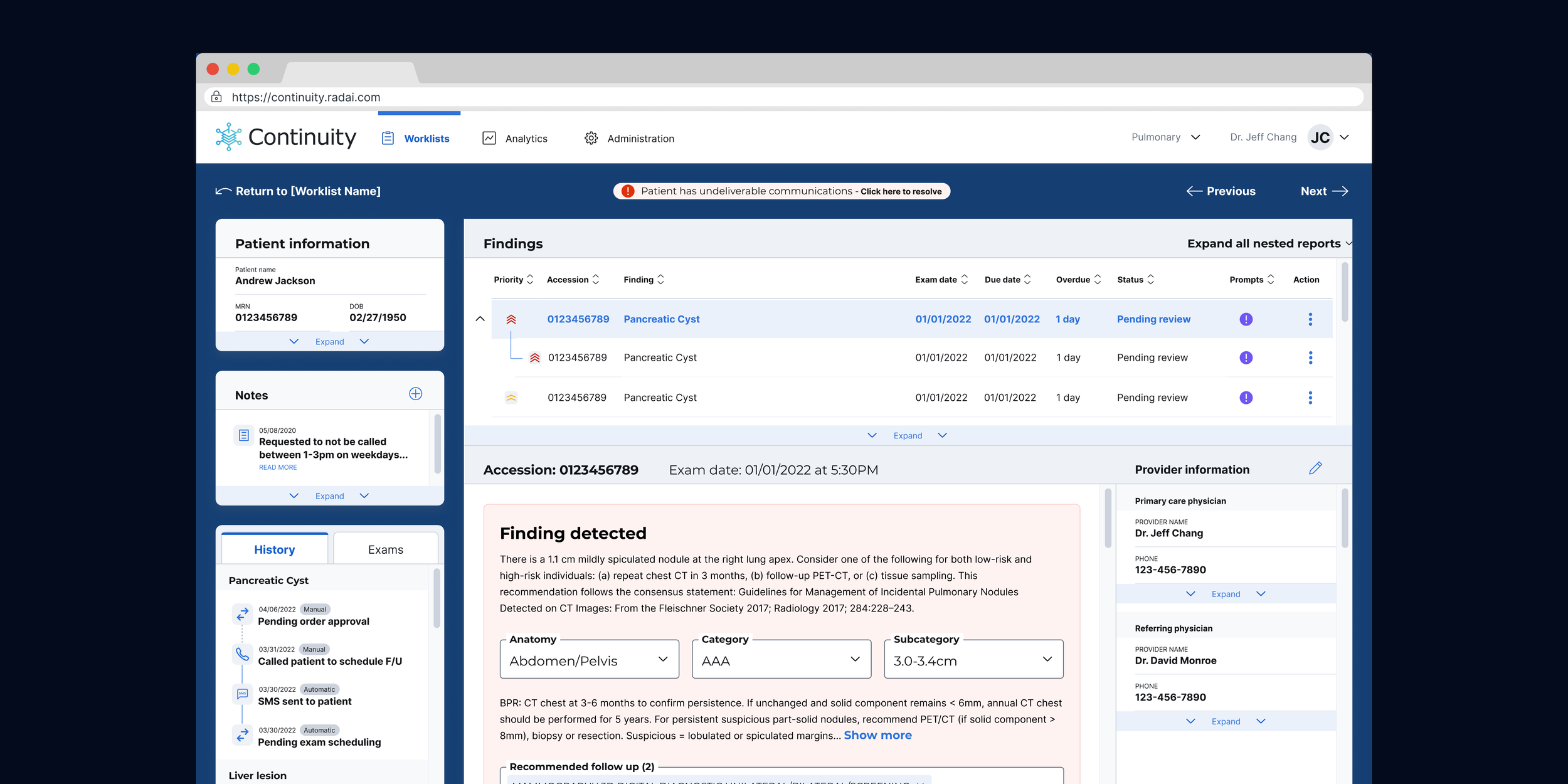
I joined as a contract product design lead, embedded across three separate product teams: Continuity, Nexus, and Reporting. Each team had grown its own design system, its own interaction patterns, and its own technical constraints. Radiologists worked in highly variable environments: hospital reading rooms, different monitor sizes, high-contrast lighting needs, and specialized hardware including handheld clickers. The core product challenge was ambitious: an on-canvas generative AI experience that could recommend findings, surface comparisons, and feed automation workflows spanning before, during, and after care. All of this had to remain scannable while displaying massive amounts of clinical data at once.
-
As the external design lead I sat inside all three product teams, partnered closely with the product manager on discovery, and worked directly with clinical stakeholders and engineering. My focus was translating complex diagnostic requirements into clear, usable interfaces while creating the shared design system that would finally let the teams move as one.
-
The product manager and I started with walk-the-store sessions that mirrored real radiologist days. We mapped typical journeys inside the actual hospital and reading-room setups, noting every friction point around data comparison, finding changes, and the constant need to keep large volumes of information visible and trustworthy.
Those sessions surfaced clear pain points: fragmented visual languages made switching between tools costly, high-contrast needs were inconsistently handled, and the early AI outputs felt buried instead of integrated into the canvas. We designed lightweight experiments to test assumptions about how radiologists would accept AI recommendations and how much data density they could scan under real lighting and hardware conditions.
From there we designed the front-end experiences with scannability and side-by-side data comparison as non-negotiable requirements. At the same time we introduced a new shared design system that included both light and dark modes (still relatively uncommon in clinical tools in 2024). That system became the bridge across the three previously independent teams.
-
The biggest early decision was to stop treating the three teams as separate design problems. Building one coherent system with light and dark modes required more upfront alignment, but it eliminated the constant context-switching cost for radiologists and for the design and engineering teams themselves.
On the generative AI canvas we chose to keep recommendations and comparison views tightly integrated rather than relegating them to side panels. That choice increased visual density, so we spent extra cycles on hierarchy, progressive disclosure, and high-contrast treatment to protect scannability. We also prioritized the highest-volume clinical workflows first instead of trying to solve every before/during/after care scenario in the initial release.
-
The platform delivered a 60% improvement in radiologist report quality. Clinical stakeholders, including leadership at Duke, specifically called out the clarity of the complex workflows. The shared design system with light and dark modes gave the three product teams a common language for the first time and made future feature work significantly faster to design and implement.
-
Working across three teams that had evolved independently taught me how costly fragmented design systems become in high-stakes environments. The walk-the-store sessions in real hospital conditions were essential; abstract personas would never have revealed the hardware and lighting constraints that shaped the final interface. If I were starting a similar engagement now I would bring clinical radiologists into the design system workshops earlier so the light and dark mode decisions could be validated against actual reading-room conditions from day one.
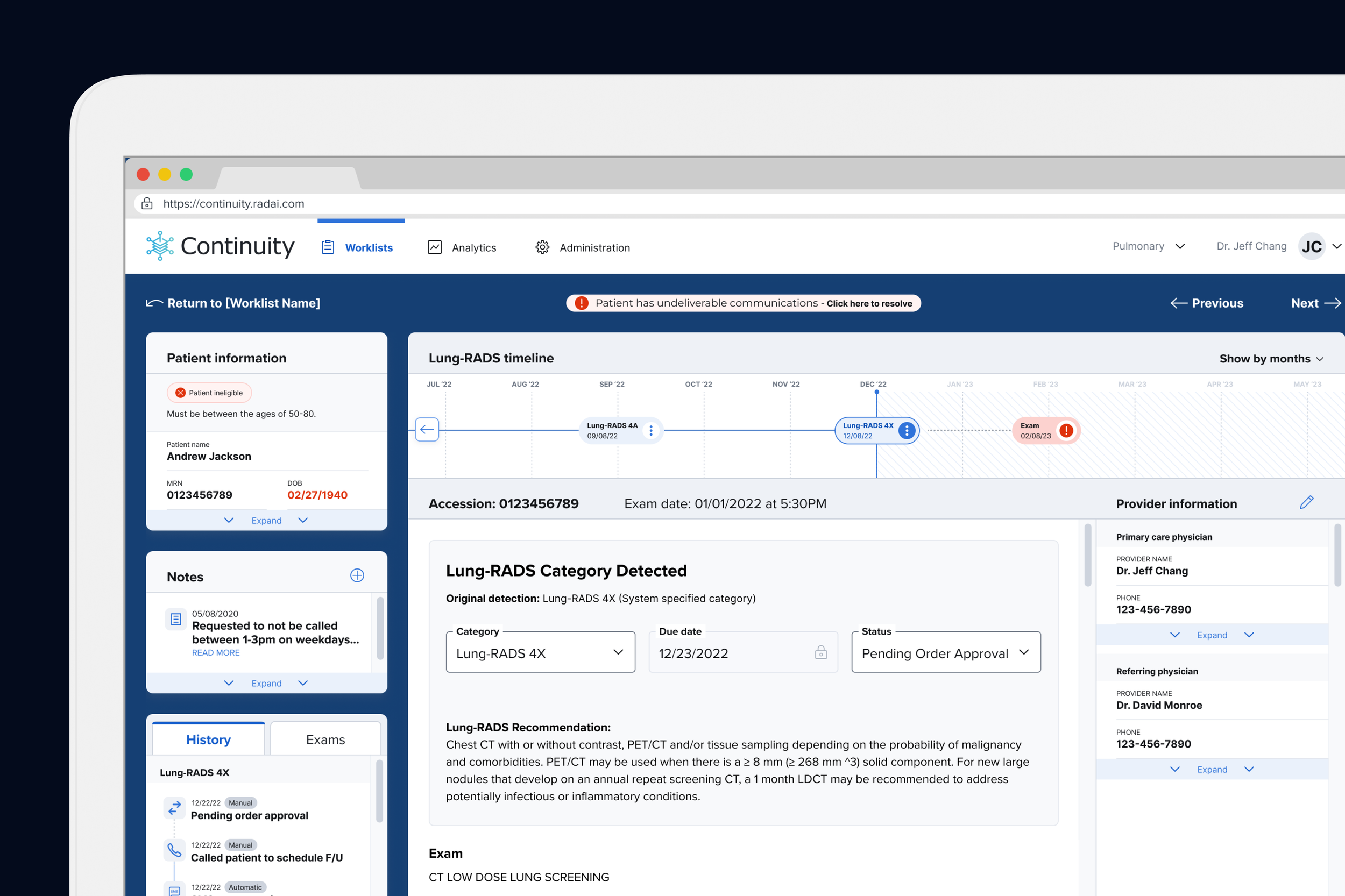
This is at the forefront of LCS (Lung Cancer Screening) programs. Your user experience and interface design is amazing. Very nice job. By streamlining the process and providing radiologists all these tools we have seen an improvement of 60% impression evaluation and recommendations to next steps which will help diagnose cases and save lives.”
— Dr. Christensen,
Director of Duke University LCS Program
and Chair of the ACR Lung-RADS Committee
“
Larger case study available upon request.
I had the pleasure of working with Michael for over two years while he was consulting as a lead product designer for Rad AI, a healthcare technology company focused on operational and generative AI for radiology. In my role as a product manager, I worked closely with Michael on building out various products, all of which had exceptional UX/UI designs thanks to Michael's hard work.
Michael is the kind of designer who can work with you on high level brainstorming that is directional at best, or maybe a wireframe or two, and turn it into outstanding designs with little need for iteration or correction. He listens very carefully to the details of what the team is trying to build, or the problem that is being solved, and makes sure that all of that feedback is considered and clearly represented in his output. When any iteration is required, he is able to provide various design options that all solve the problem in slightly different ways, which allows the team to select the best option for their use case, product, and end users.
I strongly recommend anyone seeking a top tier designer to work with Michael, and I truly hope I have the opportunity to work with Michael again in the future!”
— Scott Whitney,
Principal Product Designer