
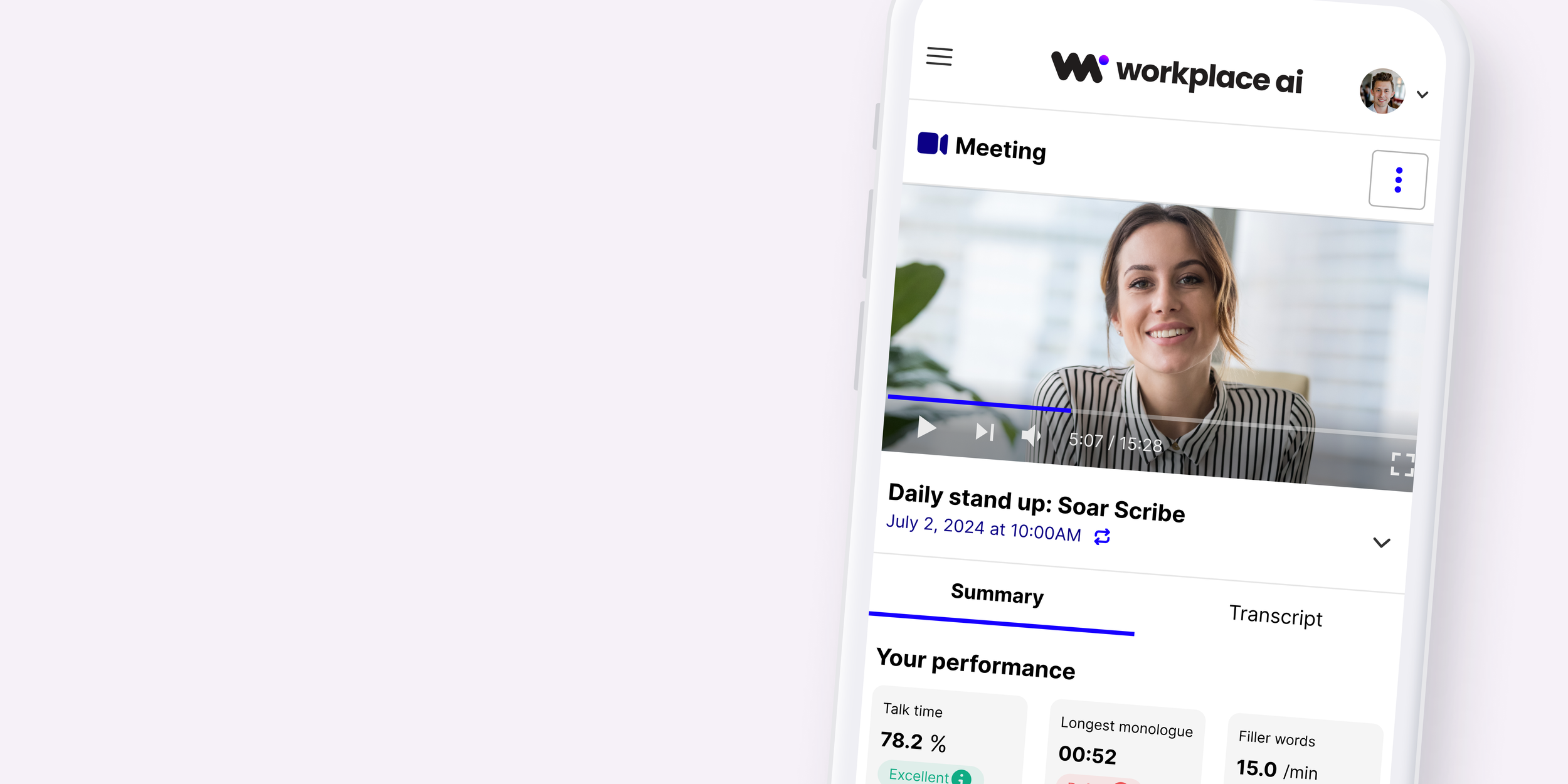
Workplace AI Coach
Led design early stages AI-powered meeting intelligence and productivity platform designed to transform conversations into structured, actionable knowledge for businesses.
2025 / Product Design Lead
Measurable Business Outcomes with WorkplaceAI
WorkplaceAI launched as one of the first AI-powered tools that could act as a true virtual coworker: capturing meeting insights, delivering real-time coaching, and integrating directly into everyday apps like Slack and Google Drive. The product reached market before Zoom offered comparable features. By aligning executives and product teams around the highest-impact opportunities, we moved from scattered ideas to a focused roadmap that turned chaotic conversations into clear, actionable outcomes for leaders, sales teams, and hybrid organizations.
First Meeting AI
to Market
Crafted
Measurable Outcomes
Unified
Design System
-
The product sat at the intersection of meeting intelligence and workplace assistance. Teams were drowning in recordings and lost follow-ups. Leaders needed clarity without adding more tools or micromanagement. The opportunity was large, but the risk was also real: we were defining a new category with no established patterns to copy. Stakeholders came with strong opinions about what “AI coaching” should mean, and the experience had to work fluidly across desktop and mobile while feeling native inside existing workflows.
-
I partnered with product and executive stakeholders to run the discovery and prioritization work. I designed and facilitated the workshops, created the opportunity tree that connected solutions to measurable business goals, and led the design of the new system and experience from first principles through usability testing and launch.
-
We began with structured workshops aimed at blue-ocean opportunities. Using an assumptions matrix that scored ideas on feasibility, viability, strategic fit, and desirability, we surfaced the riskiest and most promising bets. From there I designed lightweight experiments to derisk the highest-uncertainty assumptions before anyone committed serious engineering time.
Those experiments fed directly into an opportunity tree I built with the team. The tree organized every potential solution under the business objectives it would move, making it obvious which ideas would create the largest impact first. That visual alignment got executives and product leaders on the same page about sequence and focus.
With priorities clear, we moved into ideation. I started by creating a brand-new design system built for responsive desktop and mobile use. Patterns from that system, combined with usability testing against the distinct personas (founders and executives, sales leaders, remote and hybrid teams, HR and operations), shaped the final user journeys. New branding and visual styles rolled out alongside the product so the experience felt coherent from the first interaction.
-
The biggest early decision was to slow down just long enough to run the assumptions matrix and opportunity tree instead of jumping straight into feature design. That investment cost time up front but prevented the team from building the wrong things first.
On the product side we chose to treat the AI as a collaborative coworker rather than a passive note-taker. That meant elevating real-time coaching and context-specific answers over simple transcription. We also prioritized deep integration with tools teams already used rather than trying to become another destination app. Both choices increased technical complexity but matched how people actually work.
-
WorkplaceAI shipped as a first-to-market solution that turned meeting recordings into structured decisions, action items, and performance coaching. The opportunity tree and prioritization workshops gave stakeholders a shared view of which solutions would move the needle hardest, resulting in a focused launch rather than a scatter of features. The new design system and branding created a consistent responsive experience across desktop and mobile from day one.
-
Facilitating the assumptions matrix and opportunity tree taught me how powerful a shared visual model can be when executives and product teams start from different mental models of “what AI should do.” The early experiments were essential; they turned abstract enthusiasm into concrete evidence. If I were running a similar 0-to-1 effort today I would bring a small set of real end users into the opportunity tree sessions so the business objectives could be stress-tested against actual daily pain even earlier.
You’d be hard-pressed to find a more competent and professional designer. Their deep expertise in SaaS products and design consistently shines through in their ability to deliver top-tier solutions with speed and precision.”
— Kenny Call,
Orchardtek through ViaDesign.io
“
Larger case study available upon request.